Why Many Professionals
Avoid Autism Levels
DIAGNOSIS | INDEPENDENCE | WELL-BEING
DSM-5 introduced support levels for autism - but their misuse in everyday language has caused real harm to autistic people and their access to support.D
THE CORE PROBLEM
Levels describe support needs -
not severity of autism itself
When people say "Level 1 autism" or "Level 3 autism," they often imply a fixed, ranked scale of how autistic someone is. This fundamentally misrepresents what the levels measure: how much support a person appear to require in a specific context, at a specific time - which can change dramatically.
❌ Common Misreading
"Level 1 = mildly autistic"
This frames autism as a hierarchy of severity — as if a Level 1 person is "barely autistic" and a Level 3 person is the most autistic. It reduces a complex neurotype to a ranking, erasing individual experience and leading to denied support or dismissed struggles.
✓ What It Actually Means
"Level 1 = lower support needs observed"
The levels describe the amount of support a person appeared to need at the time of assessment, in the contexts assessed. A "Level 1" person may mask intensely, exhausting themselves. A "Level 3" person may thrive in the right environment. Neither number tells the full story.
What the DSM-5 Levels Actually Say
Each level refers to support needs observed — not a fixed trait of the person
1
Level
Support Level 1 - "Requiring Support"
Without support, noticeable differences in social communication
May appear to cope in structured environments. Often misses the hidden social curriculum. Frequently misdiagnosed or dismissed as "not autistic enough." Many Level 1 autistic people experience profound exhaustion from masking and have significant unmet needs.
⚠ Often leads to under-support — struggles are invisible to observers
2
Level
Support Level 2 - "Requiring Substantial Support"
Marked differences in verbal and nonverbal communication
Support needs are more visible in various settings. However, with the right supports in place — structured environments, sensory accommodations, communication tools — the same person may function very differently and need far less reactive support.
⚠ Need varies hugely depending on environment and available supports
3
Level
Support Level 3 - "Requiring Very Substantial Support"
Severe difficulties in verbal and nonverbal communication
Does not mean "most autistic." A Level 3 autistic person given the right environment — predictability, sensory safety, AAC tools, trusting relationships — may thrive. The same person in a chaotic, unsupporting environment may be in near-constant distress.
⚠ Can lead to paternalism and underestimating the person's agency
Support Needs Shift With Context
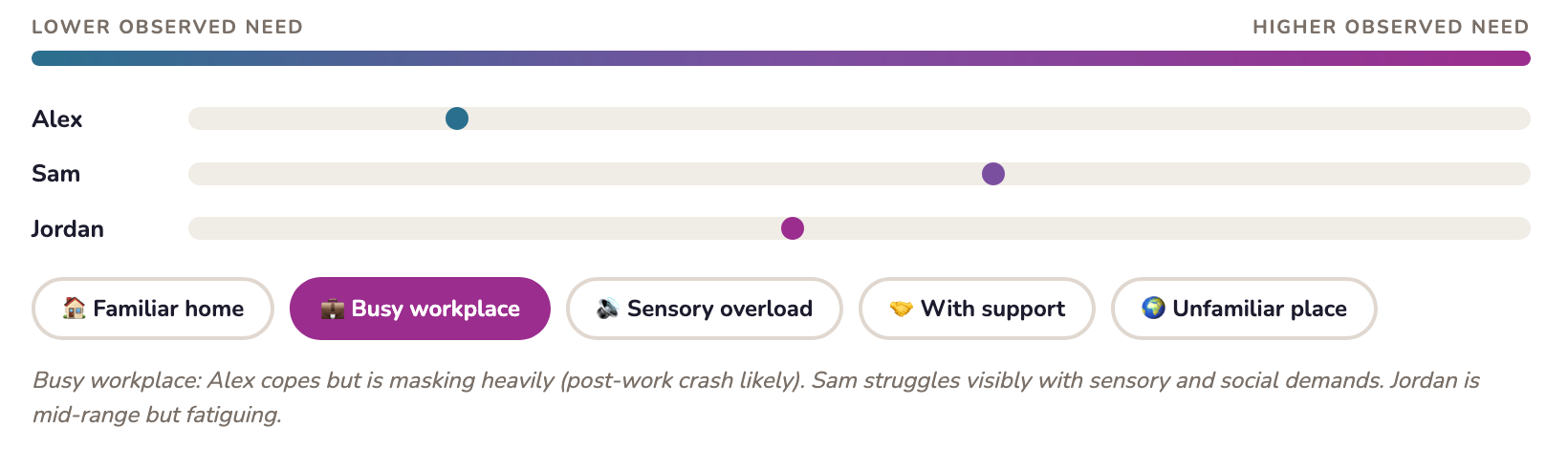
The same person can present very differently across situations. Select a context to see how observed support needs shift.
Why Many Professionals Avoid Using Levels in Diagnoses
Increasingly, clinicians omit or de-emphasise levels in diagnostic letters.
Levels are a snapshot, not a stable trait
A diagnosis captures one point in time, in specific contexts. The level assigned at age 8 in a structured assessment may bear little resemblance to that person's needs at age 25, or in a different environment. A number implies permanence that doesn't exist.
Masking distorts the picture
Many autistic people — particularly women, girls, and people of colour — learn to suppress and camouflage autistic traits to fit in. During an assessment, they may present as needing less support than they truly do. The level reflects performance, not lived experience.
Levels are misused to gatekeep support
Services sometimes use levels as binary cutoffs: "You're Level 1, so you don't qualify." This conflates a descriptor of observed behaviour with a measure of need — and denies help to people who are quietly struggling. The level was never designed to be an eligibility criterion.
They reinforce a hierarchy that autistic people reject
The autistic community has consistently critiqued language that ranks autism. Phrases like "high-functioning" and "low-functioning" — which levels echo — erase complexity. A "Level 1" label can mean your pain is dismissed; a "Level 3" label can mean your capabilities are ignored.
A profile of needs tells you far more
Many clinicians now prefer a descriptive profile: sensory sensitivities, communication style, executive function, co-occurring conditions, masking tendencies, and environmental factors. This gives a richer, more actionable picture than a single number ever could.
The Same Person, Different Contexts
Observed support needs can shift dramatically depending on environment - not the person's underlying neurology.
Home (familiar)
Predictable routine, sensory control, no masking required. Person may appear highly independent and need little support.
⚠ lower need
Open-plan office
Noise, unexpected interruptions, social demands. Same person may struggle significantly, lose executive function, or shut down.
⚠ higher need
Medical
Bright lights, unfamiliar space, communication under pressure. Anxiety may cause full shutdown — even for someone "Level 1."
⚠ higher need
Remote / async work
Control over environment, written communication, less social pressure. Many autistic people thrive and show minimal support needs.
⚠ lower need
Social
Unpredictable conversation, sensory input, masking expectations. Exhausting even if the person appears to cope — the cost comes later.
⚠ higher need
Right accommodations
With appropriate support — AAC, quiet spaces, clear communication — a "Level 3" person's visible support needs can reduce dramatically.
⚠ reduced need
Autism is not a spectrum from "mild" to "severe."
It's a broad constellation of neurological differences — each person has their own profile of strengths, challenges, and support needs that shift with context. A level number will never capture that. Good support starts with listening to the individual.